Embeddings: How LLMs Represent Meaning
| Text | Embedding (simplified) |
|---|---|
| "cat" | [0.82,
0.15, -0.32, 0.71] |
| "kitten" | [0.79,
0.18, -0.30, 0.69] |
| "dog" | [0.76,
0.21, -0.25, 0.65] |
| "car" | [-0.12,
0.84, 0.71, -0.20] |
The important idea is: Similar meanings → vectors that are close together
"I purchased a car."
"The vehicle was expensive."
"I bought a new automobile."
"I bought a new automobile."
automobile ≈ car ≈ vehicle
A = [1, 2, 3]
B = [1, 2, 2]
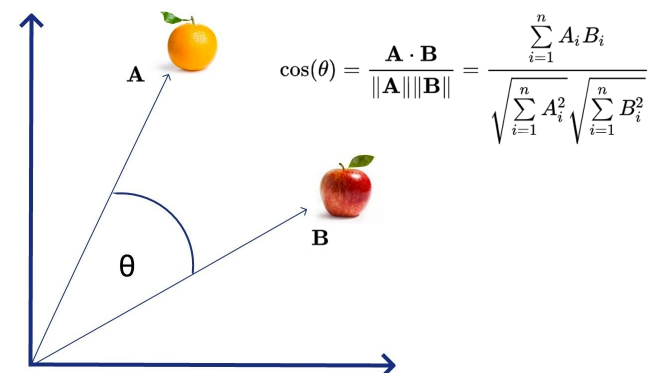
-1 → completely opposite
0 → unrelated
+1 → very similar
import numpy as np
texts = {
"dog": np.array([0.9, 0.1, 0.2]),
"puppy": np.array([0.8, 0.2, 0.2]),
"cat": np.array([0.8, 0.1, 0.3]),
"car": np.array([0.1, 0.9, 0.8]),
"truck": np.array([0.2, 0.8, 0.7])
}
Python
def cosine_similarity(a, b):
return np.dot(a, b) / (np.linalg.norm(a) * np.linalg.norm(b)
)
print(cosine_similarity(texts["dog"], texts["puppy"]))
print( cosine_similarity(texts["dog"], texts["car"] ) )
dog vs puppy →
cosine=0.99 → high similarity
dog vs car → cosine=0.33 → lower similarity
pip install sentence-transformers
Python
from sentence_transformers
import SentenceTransformer
model = SentenceTransformer("all-MiniLM-L6-v2")
sentences = [
"I love my dog.",
"My puppy is very cute.",
"Cats are wonderful pets.",
"I bought a new automobile.",
"The vehicle is very fast."
]
embeddings = model.encode(sentences)
print(embeddings.shape)
(5, 384)
Python
from sklearn.metrics.pairwise import cosine_similarity
similarity = cosine_similarity(embeddings)
print(similarity)
[[1.0000001 0.59701616 0.54455847 0.27561283 0.06691159]
[0.59701616 1. 0.4266082 0.15517783 0.08879378]
[0.54455847 0.4266082 1. 0.1321229 0.13605565]
[0.27561283 0.15517783 0.1321229 0.9999999 0.34935087]
[0.06691159 0.08879378 0.13605565 0.34935087 1. ]]
documents = [
"Dogs are popular household pets.",
"Cats are commonly kept as pets.",
"Toyota produces automobiles.",
"Electric vehicles are becoming popular.",
"Puppies require special care.",
"Machine learning is used for medical diagnosis."
]
"How should I take care of my puppy?"
query = "How should I take care of my puppy?"
query_embedding = model.encode([query])
document_embeddings = model.encode(documents)
scores = cosine_similarity(query_embedding, document_embeddings)[0]
Python
results = sorted(zip(documents, scores), key=lambda x: x[1], reverse=True)
for document, score in results:
print(f"{score:.3f} {document}")
0.719 Puppies require special care.
0.390 Dogs are popular household pets.
0.227 Cats are commonly kept as pets.
0.060 Machine learning is used for medical diagnosis.
-0.024 Toyota produces automobiles.
-0.052 Electric vehicles are becoming popular.
Query:
"How should I take care of my puppy?"
Document:
"Puppies require special care."
|
Input |
Output |
|
| Embedding model | "What is Alzheimer's disease?" | [0.023, -0.145, 0.081, ..., 0.034] |
| Generative LLM | "What is Alzheimer's disease?" | "Alzheimer's disease is a neurodegenerative disorder..." |
